Austin CPA Experts AlternativeA price before you sign.
The fee is written for a named scope. Monthly close, payroll setup, and the return are separate lines when they are separate jobs.
Hold the fee.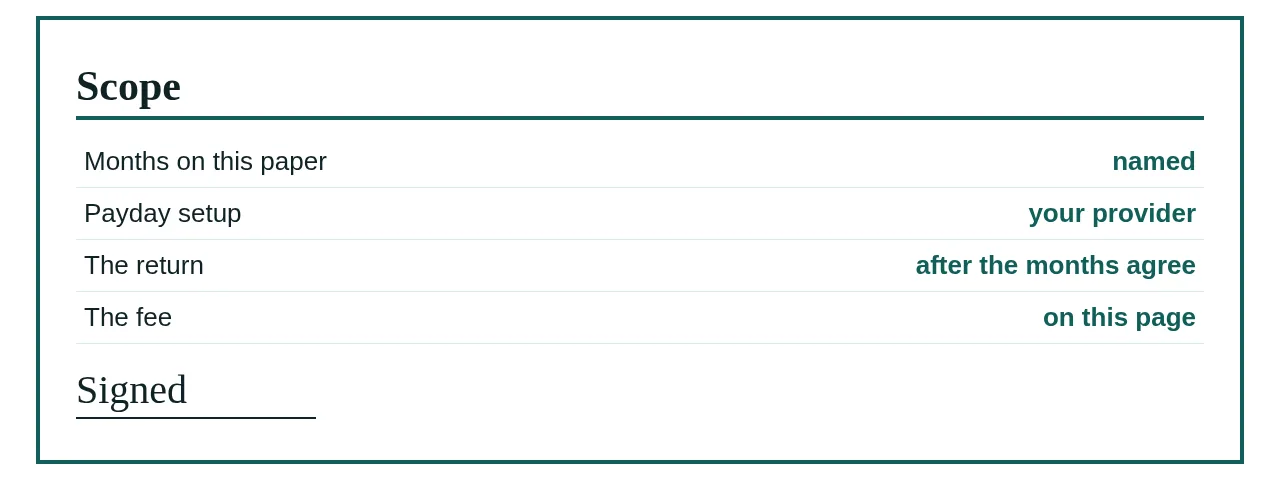
What the writing has to contain.
A useful writing lists the months in the close, says whether payday setup is part of that writing, and says the return waits on those months. If any of those are missing, it is not a price you can hold us to.
Catch-up is priced on its own because it ends. The monthly close is the work that follows. Mixing them into one number makes the end of cleanup invisible, and then the fee never steps down.
The return is priced when we know the year has months under it. We do not quote a return against a file we have yet to see and then act surprised by the gap.
What a first invoice looks like.
A first invoice names three lines when they are three jobs. The months come first, from the oldest open month through the month you would call finished. Payroll setup is the next line, and it ends when the registrations on the provider you already run are done. The return is the last line, and it waits until those months lock.
The paper names the months, the setup, and the return, or it is not a price you can hold us to. You should be able to read that paper a month later and still match it to the job you remember, without a translator.
If the job changed, the paper changes before the work does. A fee that cannot be pointed at a month, a setup, or a return is not the invoice this practice sends. The writing stays the record of what you agreed to buy.
What is outside the fee.
A lender's request for a signature on the figures is outside. A formal examination is outside. Becoming your payroll provider is outside. Those nos are part of the price, because they stop a later surprise.
Work that appears after the start gets its own quote, and it waits until you accept that quote. You can say no. We can say the monthly work pauses until the extra decision is made.
Ending the work takes a written note from you or from us. Work already finished is still on the bill. Your records come back to you. That sentence belongs in the same paper as the fee.
How people get talked into a fog.
A monthly number with no scope feels calm. It is also how a year of open months hides inside a retainer. We would rather show you the open months on day one.
A low number that assumes your file is current is not a kindness if the file is not current. The kind version is the higher, shorter catch-up, named as catch-up.
The paper will not grow a pretend savings number just to look clever. If we have yet to measure your year, we do not predict it.
Before you sign anything, including ours.
Read last year's return first, or let us read it with you. A price that ignores last year's elections is a price for a different company than the one you have.
Ask who answers the phone after the first week. On this practice the answer is the same people who scoped the work.
If the paper and the conversation disagree, the paper wins until it is rewritten. A number you can point at on the paper is the fee, and a number you only remember is not.
A number without a month is not a fee.
A paper that skips the first month and the last month should not be signed. A monthly amount floating free of months hides a year of catch-up inside a calm retainer. Ask for the months in ink.
We will put catch-up on its own line when catch-up is real. When it ends, the line ends. The monthly close that follows is a different line. You should be able to see the step down without calling us to interpret the paper.
Name the scope first.
Tell us whether you need catch-up, a monthly close, or both.

You will be talking to the Steven Palmieri practice.