Austin CPA Experts AlternativeRead last year first.
The prior return already made choices. This year has to live with them, so we read that file before we talk about keeping us.
Open the file.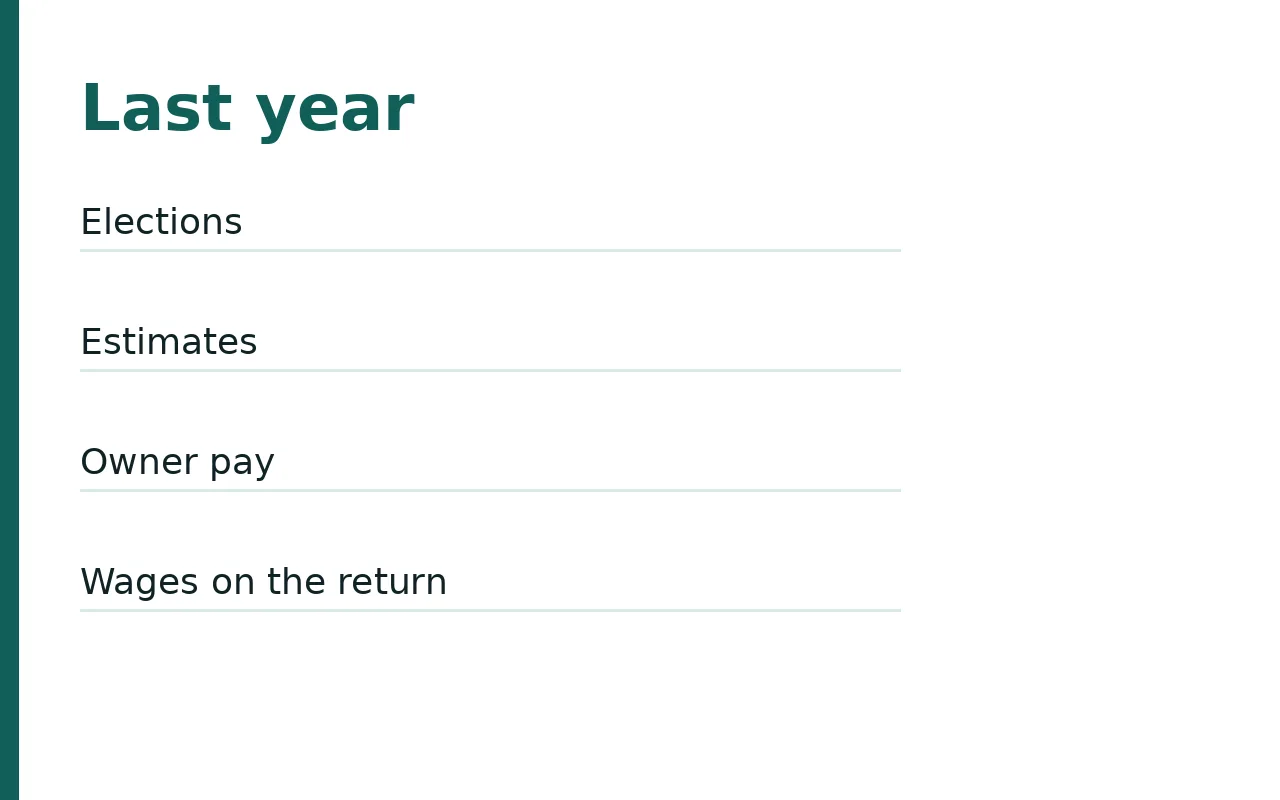
What we are looking for.
Elections, estimates, the way owner pay was treated, and whether payroll filings match the wages on the return. Those four readings tell us if the books and the return were ever introduced to each other.
We are not hunting for a villain in last year's preparer. We are hunting for facts this year cannot unknow. A method that was used is still a method until someone changes it on purpose.
If pages are missing, we say which pages. A partial return is a partial reading, and the price conversation waits on the gap.
Last year's return comes first.
Last year's return is the starting point. You read it before you plan a new year, or you plan around a filing you have not opened.
A filed return is done, and the new year has to be planned around it.
Estimates and the rest of the calendar.
If last year paid estimates, this year inherits the rhythm. April is when that rhythm gets checked against months that have actually closed. We do not invent a new rhythm to make a meeting feel productive.
No dollar target is promised on this page. The question is whether the estimates had a file under them, or whether they were a round number someone hoped would be close.
A franchise report in May can sit beside that reading. The short sheet is ordinary. It is not a substitute for the return, and the return is not a substitute for the monthly tie.
When last year should slow you down.
If the return and the books disagree by a wide margin, the first engagement is a reconciliation of that disagreement, not a cheerful monthly start. You will hear that during the opening conversation, not after month three.
If a notice is open, the notice is part of last year even when the date on it is this year. Bring it. Do not summarize it from memory.
None of this is a threat. It is the order that keeps a new engagement from repeating the silence that made the file hard.
Then the monthly work.
Once last year is understood, a first month has a shape. Tie the bank, name what is still open, list payday, and stop. A first month that tries to retell three years will do none of them well.
The page on a good first month is the next reading if you want the picture of week one through week four.
You can also decide, after the reading, that you do not need us. Leaving with a clear no is a good use of those 30 minutes.
Four readings, then a stop.
We read elections, estimates, owner pay, and whether wages on the return match the payroll filings. Then we stop and tell you what those four say. We do not keep reading until we find a story you would enjoy. The filed return is allowed to be dull. Dull and consistent is a gift.
If one of the four is missing, the reading is partial and we say which page is gone. A price built on a partial reading gets labeled partial. You can wait for the missing page. Waiting is cheaper than guessing.
Bring the notice if one is open, even when the date on it is this year. The notice is still about the year that was filed. Memory of a notice is not the notice. The letter has a number on it and a date, and those are the facts.
Which year should we read.
The prior return is the document. A summary of it is not.

You will be talking to the Steven Palmieri practice.