Austin CPA Experts AlternativeWhat a first month looks like.
A good first month ties the bank, names what is still open, and lists payday. It does not pretend the whole history is clean.
See the tie.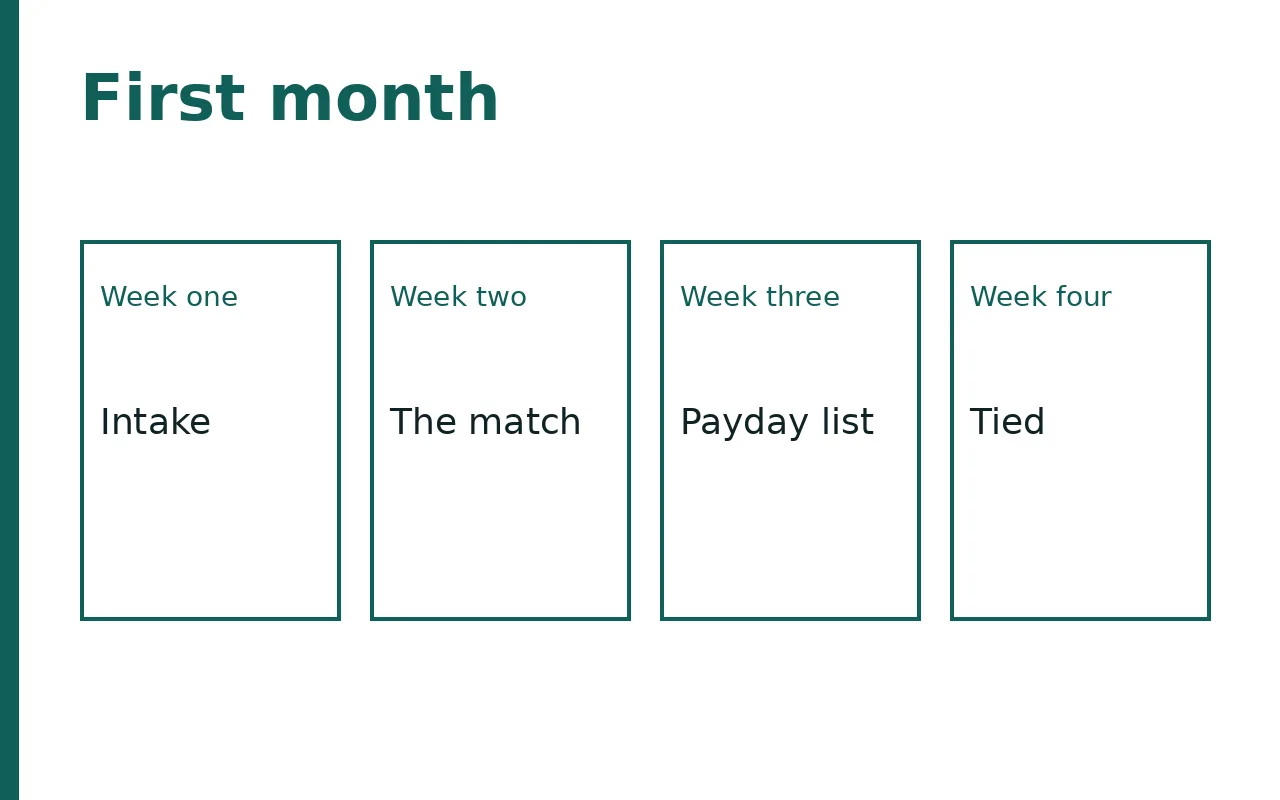
Week by week, without a ribbon.
The first week is intake. We learn which accounts exist and which statements you can actually get. The second week is the match. Lines that agree get accepted. Lines that do not agree get a name.
The third week is the payday list, if setup is in the scope. The provider stays the provider. We write who files what. The fourth week is a lock or a written list of why the lock is not honest yet.
A pretty report in week one is a decoration. We would rather hand you a short list of open items than a statement that hides them.
The plain habit comes first.
The bank tie is a plain habit, and a first month has to learn it before any newer report is worth printing.
People want the new report first. In the first month the plain bank tie is the point.
What done means.
Done means you can point at a month and say the bank agrees, the open items have names, and payday has a provider. It does not mean every prior year is healed.
If catch-up is longer than a month, the first month of the engagement might be the oldest open month, not the calendar month we are standing in. We will name the month under the lock, even when it is an older one.
We lock a month only when the tie is real. An open month stays open in the conversation, even if that is less satisfying.
What you will feel.
Relief is the feeling we are aiming at, and it arrives when a difference finally has a name. Anxiety before that is normal. We will not talk you out of it with a forecast.
You may also feel impatient. A first month that is honest is slower than a first month that is performed. We pick honest.
If the feeling at the end of the month is that we avoided the hard account, say so. The hard account is the job.
Then the habit.
The second month should be shorter, because the payday list exists. If it is not shorter, something in the first lock was soft, and we reopen it rather than building on it.
The return stays downstream. It drinks from locked months. It does not replace them.
You can read who keeps that habit on the record page. The person does not rotate away after the first invoice.
What we hand you at the end.
You should be able to point at one month and say the bank agrees, the leftovers have names, and payday has a provider. If any of those three is missing, the month is not done, and we will not call it done to make the calendar look tidy.
The handoff is a short list, not a binder. Open items, who owns each one, and the date of the next close. A binder that hides the list is a performance. We are not interested in the performance.
The second month should be shorter because the payday list exists. If it is not shorter, the first lock was soft and we reopen it. Building on a soft lock is how a file looks current and is not.
How the first month starts.
Tell us the oldest month you still trust, even if it is not recent.

You will be talking to the Steven Palmieri practice.